How to Stack Coupons and Freebies for Maximum Savings
The first time you see a $24 cart drop to $9, it feels a little silly that you ever paid full price without checking.
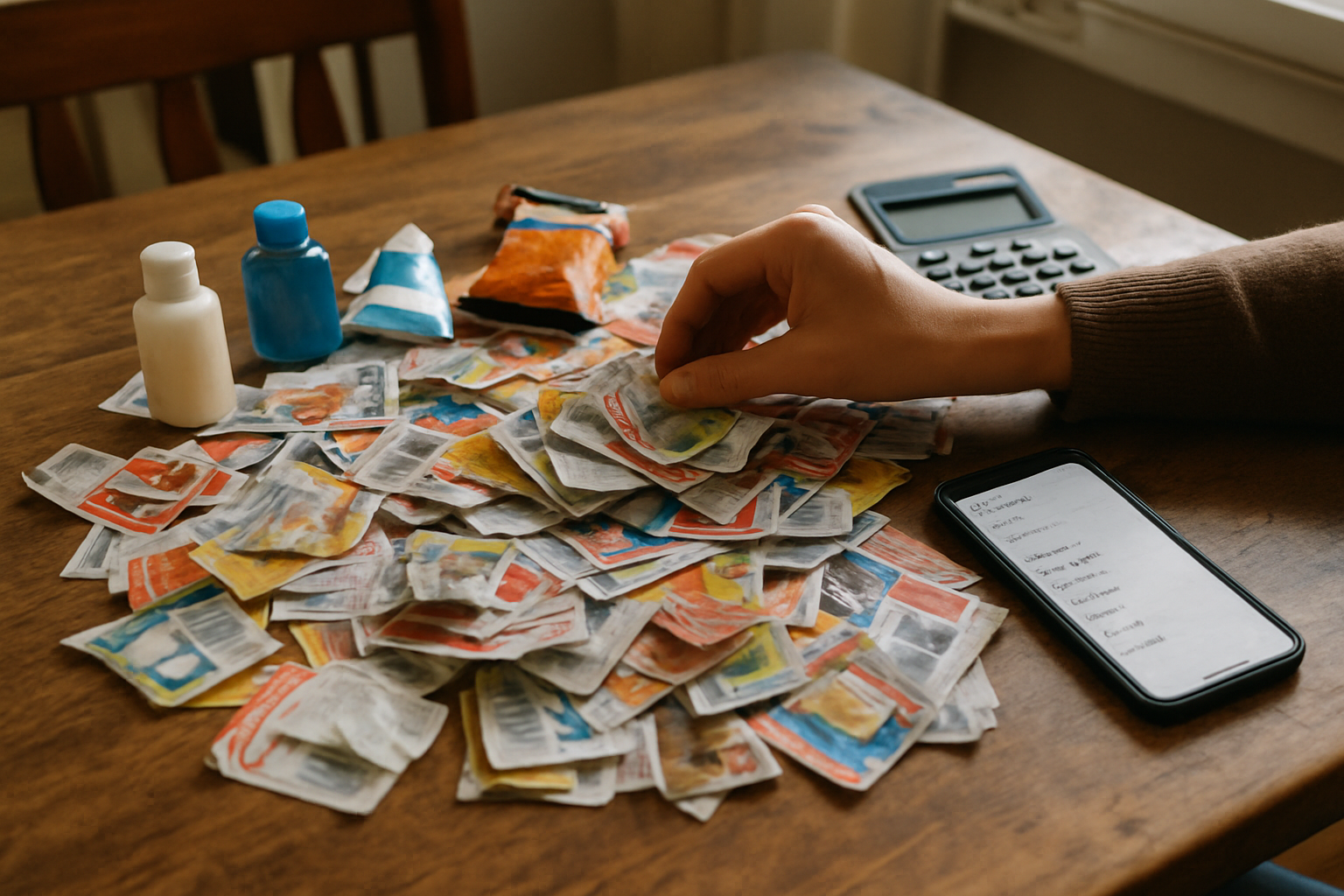
The first time you see a $24 cart drop to $9, it feels a little silly that you ever paid full price without checking. That is the useful side of coupon stacking. You are not hunting for a miracle code for two hours. You are putting a few discounts in the right order so each one does part of the work.
For most households, the biggest savings are not from extreme couponing. They come from repeat purchases: groceries, pharmacy items, kids' clothes, takeout, household basics, coffee, pet food, and gift cards for places you already use. A few simple habits can shave $30 to $100 or more off a normal month without turning your kitchen table into a pile of flyers.
Look, not every deal is worth chasing. A free sample that requires $40 in shipping is not a freebie. A coupon for something you would never buy is not savings. The goal is to spend less on things that were already on your list, then use legitimate freebies to make the budget stretch a little further.
What coupon stacking actually means
Coupon stacking means using more than one valid discount on the same purchase. The exact combinations depend on the store, but the common layers are:
- A sale price or clearance markdown
- A store coupon, either digital or paper
- A manufacturer coupon or rebate
- A cash-back offer from an app
- A discounted gift card
- Store rewards or loyalty points
- A credit card offer or cash-back category
Not every retailer allows every layer. Some stores let you combine a manufacturer coupon with a store coupon. Some do not. Some rebate apps allow receipts from sale items, while others exclude items that used another offer. The practical rule is simple: read the offer terms before you build a shopping trip around it.
A basic example: a family-size laundry detergent is regularly $14.99. It goes on sale for $11.99. Your store app has a $2 store coupon. You have a $2 manufacturer coupon, and Ibotta has a $1 cash-back offer for that exact product. If all four are allowed, your final cost is $6.99 after the rebate. If you paid with a gift card bought at a 10 percent discount, your out-of-pocket cost is effectively closer to $6.29.
That is a meaningful savings on something you were going to buy anyway. The key phrase is something you were going to buy anyway.
Start with one store, not every deal on the internet
The fastest way to burn out is downloading twelve apps, joining fifteen email lists, and trying to match every promotion. I have found that a better setup is one main grocery store, one pharmacy or big-box store, one cash-back app, and one browser tool for online shopping.
For groceries and household items, apps such as Ibotta, Fetch, Shopmium, Checkout 51, and store apps can be useful. Availability changes by retailer and region, so do not assume the offer you see online will appear at your local store. For online purchases, Rakuten, Capital One Shopping, Honey, and RetailMeNot can help you compare cash-back rates and coupon codes.
Pick the places where you already shop. Then learn those programs well.
For example, Target Circle, Walmart Cash, Kroger digital coupons, CVS ExtraCare, Walgreens myWalgreens, and Safeway or Albertsons-style store loyalty programs all have their own rules. You do not need to master all of them. If your household regularly goes to one of those stores, learning that one app can pay off quickly.
I think CVS is a good example of a program that can be excellent or a complete waste of time depending on your habits. ExtraBucks can make personal care items, seasonal candy, and household basics very cheap when you combine sale pricing with store coupons and manufacturer offers. But if you are buying random things just to earn a reward, the math falls apart. A $10 ExtraBucks reward is not a win if it made you spend $35 on items you did not need.
Build your stack in the right order
Most good stacks start before you leave the house. Do not walk into the store and hope an offer works. Spend ten minutes checking the app and making a short list.
1. Check the regular price and sale price first
A coupon is only useful if the starting price is reasonable. This sounds obvious, but stores count on people seeing “20 percent off” and not checking whether the item is still more expensive than somewhere else.
Use the retailer's app or website to see current pricing. For groceries, compare unit prices when possible. A large package is not always cheaper per ounce, especially when a smaller size has a coupon or rebate attached.
If an item is $8.99 at one store and $6.49 on sale somewhere else, a $1 coupon does not automatically make the first store the better deal.
2. Clip store coupons before shopping
Digital store coupons are usually the easiest layer because they attach to your loyalty account. Clip them before checkout. Some need to be clipped before you add the item to your cart, and some expire overnight.
Check whether the coupon is for an exact size, scent, flavor, quantity, or brand line. “Save $3 on two” is not the same as “save $3 on one.” I have seen plenty of carts miss a discount because the shopper grabbed the 14-ounce product when the offer required the 18-ounce product.
3. Add manufacturer coupons carefully
Manufacturer coupons may come from a brand website, a coupon app, a mailed insert, or a printable coupon provider. Many retailers accept one manufacturer coupon per item, but policies vary. Digital manufacturer coupons in a store app can also be treated differently than paper versions.
Read the fine print. If you are using a manufacturer coupon, do not assume you can use another manufacturer coupon on the same item. That usually is not allowed.
4. Claim rebates after checkout
Cash-back apps are often where the final savings happen. Ibotta, Fetch, Shopmium, and Checkout 51 generally work by having you scan or submit a receipt, though the process differs by app and retailer.
Before buying, open the offer and check these details:
- Does it require a specific store?
- Does it require a particular size or variety?
- Can you redeem it more than once?
- Does the offer exclude coupons or other discounts?
- How long do you have to submit the receipt?
Do this before leaving the parking lot if you can. Receipts get lost, and offers can disappear. I keep a simple rule: submit rebates while the bag is still in the car.
5. Pay with discounted money when it makes sense
Discounted gift cards are one of the least flashy ways to save, and one of the best. If you know you will spend money at a particular retailer anyway, buying a gift card at 5 to 15 percent off lowers every purchase before coupons even enter the picture.
You can find current options through discounted gift cards, but compare the final price and make sure you are buying from a reputable source. For a store you use weekly, a 10 percent discount on a $100 gift card is a clean $10 saved. That is more useful than a stack of tiny offers for products you do not need.
I would be cautious with gift cards for businesses you rarely visit. A deal is not great if the balance sits unused for two years. Also, do not tie up grocery money in a large gift card just because it is discounted. Buy amounts you can reasonably use in the next month or two.
Use cash-back portals for online orders
Online stacking has its own routine. Before checking out, search for a promo code, compare cash-back portals, and make sure you are not giving up a better discount by using the wrong code.
Rakuten is useful because many retailers offer a percentage back, sometimes more during seasonal promotions. Capital One Shopping can show price comparisons and test available codes. Honey can apply codes automatically, although I would not treat it as a guarantee that you got the best deal. RetailMeNot also lists promo codes and occasional cash-back offers.
Here is a normal, realistic online stack:
- A pair of kids' shoes is marked down from $50 to $35.
- You use a 15 percent email sign-up code, taking off $5.25.
- You shop through a portal offering 6 percent cash back on the pre-tax purchase, about $1.79 back.
- You pay with a card offering 2 percent cash back, another roughly 60 cents.
Your $50 shoes cost about $29.16 before tax after all savings. That is not life-changing on one order. Do it across school clothes, holiday gifts, and household purchases, and it adds up.
One warning: cash-back portals sometimes deny rewards when you use an unapproved promo code, return part of the order, or click away from the retailer's site before checkout. Take a screenshot of the offer rate and order confirmation. If your cash back does not track, those screenshots help when you file a missing-rewards request.
If you need a quick place to check deals before ordering, the shopping storefront with current products and stores can be a useful starting point. Still compare prices. A featured deal is not automatically the lowest price available that day.
Freebies work best when they replace a planned purchase
Freebies are fun, but they can also become clutter. I am picky about them now. I look for free food, useful samples, product credits, store rewards, free shipping offers, and loyalty-program items I can use without adding a bunch of extra spending.
Restaurant and retail apps are often the easiest route. Many chains offer a sign-up reward, periodic app-only deals, or points toward free items. A free drink with a planned lunch, a free side with a family order, or a $5 reward on a regular purchase is practical. Driving 25 minutes across town for a free cookie usually is not.
Birthday Hunter is a free app and website where you can find deals, freebies, and rewards year-round. It is useful beyond birthday perks because it gives you one place to check for offers before you buy. If you are building a list of apps to keep, start with the ones you genuinely use, then look through apps that give birthday freebies for programs that also send regular promotions and loyalty rewards.
Yes, birthday rewards can be worthwhile too, especially if you already belong to the program. A free meal, dessert, beauty item, or account credit can replace something you would have paid for. But do not join fifty programs just because the word “free” is attached. Your inbox will get ugly fast, and some offers require a purchase or have short redemption windows.
For people searching locally, phrases like “birthday freebies Vancouver” can turn up city-specific lists, but check the actual location in the app before making a trip. Franchise participation varies more than people expect. A deal listed nationally may not be honored at every location.
Combine rewards with a real shopping list
The best couponers I know are not buying the most stuff. They are buying with a list. That is what prevents coupon stacking from becoming expensive.
Keep a running list in your phone with three categories:
- Need this week: milk, diapers, detergent, prescriptions, lunchbox snacks.
- Need soon: toothpaste, trash bags, shampoo, pet food.
- Only if deeply discounted: backup cleaners, pantry staples, seasonal gifts.
Then match offers against the list. If toothpaste is on the “need soon” list and a pharmacy has it for $3.99 with a $2 coupon and $2 in rewards back, that is a good time to buy. If toothpaste is not on any list, you probably do not need six tubes just because they are cheap.
There is an exception for products with a long shelf life that your family uses constantly. If you have room and the deal is genuinely good, stocking up can make sense. We buy things like toilet paper, laundry detergent, soap, and pantry staples anyway. Buying a two or three month supply at a low price can protect your budget from price jumps later.
Do not stockpile perishables unless you have a clear plan. A freezer full of food you forget to eat is not savings.
Watch for the stacking traps
Here is the thing: stores and apps are good at making spending feel like saving. You need a few guardrails.
Do not chase a reward you would not otherwise earn
A common offer is “Spend $50, get $10 back.” If your normal cart is $42, adding $8 of useful household supplies might be fine. Adding $8 of random snacks just to trigger the reward is not always smart. You spent $50 to receive $10 in store credit, and that credit may expire or require another purchase.
Think of it as a discount on planned spending, not free money.
Do not ignore shipping and minimum purchase thresholds
Online freebies often get ruined by shipping. A “free” sample that costs $7.95 to ship is usually not worth it. The same goes for spending an extra $18 to avoid a $6 shipping fee unless those extra items were already needed.
Sometimes a retailer has free store pickup. That can be the better move, as long as the pickup location is already on your route. Saving $5 in shipping is not helpful if the drive costs you more in fuel and time.
Be careful with buy now, pay later offers
Some retailers promote a discount for using a buy now, pay later service. I think this is one of the more overrated forms of “savings” for everyday purchases. A $10 discount can become expensive if the payment schedule causes an overdraft, late fee, or more spending than your budget can handle.
If you cannot comfortably pay for it today, the coupon usually is not the answer.
Check expiration dates on rewards
Cash-back balances, digital coupons, store credits, and loyalty points can all expire. Set a calendar reminder for higher-value rewards. I would not bother setting reminders for 25 cents, but I would for a $10 store reward or a free entree.
For birthday perks, the expiration window can be especially short. If you are planning around them, keep the master list of birthday freebies handy and verify the current terms in each business's app or email. A simple “happy birthday” offer is only useful if you know whether it expires that day, that week, or later in the month.
A realistic weekly savings routine
You do not need a complicated spreadsheet to make this work. Here is a routine that takes about 20 minutes before a regular shopping trip:
- Check your fridge, pantry, and household supplies.
- Make a short list based on what you actually need.
- Open your main store app and clip relevant digital coupons.
- Check Ibotta or another rebate app for matches.
- Look for one store reward or freebie that fits your existing trip.
- Compare the final price on big-ticket items, not every $1 snack.
- Submit receipts as soon as you are done shopping.
A family could reasonably save $8 to $20 on an ordinary grocery and household run this way, depending on what is on sale. Add a few restaurant rewards, an online cash-back purchase, and discounted gift cards over the month, and getting to $50 or more in monthly savings is realistic for many households.
Some weeks you will save almost nothing. That is fine. The goal is not to win every shopping trip. The goal is to make better choices consistently.
Where I think the biggest savings are
If you have limited time, focus on these before anything else:
- Grocery store digital coupons: Low effort, especially when tied to things you already buy.
- Cash-back apps for planned purchases: Best when you check before shopping and submit receipts promptly.
- Discounted gift cards: Great for stores and restaurants you already use regularly.
- Store loyalty rewards: Worth joining for your main grocery, pharmacy, coffee, and restaurant stops.
- Online cash-back portals: Useful for larger online purchases, school shopping, gifts, and replacement items.
What is less worthwhile? Spending hours hunting one-time promo codes for a $12 order. Driving out of your way for a low-value freebie. Buying products because a rebate makes them “cheap.” And signing up for every rewards club that promises a small treat.
You do not have to do all of this. Use the parts that fit your household. Start with one stack, one app, and one regular purchase. Once you see the savings land, it gets easier to spot the next good opportunity.
FAQ
Can you use a store coupon and a manufacturer coupon together?
Often, yes, if the retailer allows it and both coupons apply to the exact item. Many stores treat those as separate discount types. Read the store coupon policy and the coupon terms, since some digital manufacturer coupons cannot be combined with another manufacturer offer.
Can you stack coupons with Ibotta or other cash-back apps?
Sometimes. Many cash-back offers work on items purchased with coupons, but every offer has its own terms. Check whether the rebate excludes other discounts, requires a specific retailer, or limits the number of redemptions. Save your receipt until the cash back posts.
What is the easiest way to start coupon stacking?
Choose the store where you already shop most often. Download its app, join its loyalty program, clip coupons for items on your list, and check one rebate app before you go. Do that for a month before adding more apps or more complicated deals.
Are freebie apps actually worth it?
They can be, especially if they offer things you would otherwise buy. Free food, store credits, samples with free shipping, and loyalty rewards are usually more useful than random promotional items. Skip anything that requires a large purchase, a long drive, or expensive shipping.
Do discounted gift cards work with coupons and rewards?
Usually, yes. A gift card is simply a payment method, so you can often use it after sale pricing, coupons, and rewards have already reduced the total. Check the retailer's policy for any unusual restrictions, but this is one of the simplest ways to add another layer of savings.
Brands mentioned in this post


Related Posts
Related Guides
Birthday Discounts for Nurses, Teachers, Military, and Seniors 2026: 40 Programs That Stack with Standard Birthday Rewards
The definitive 2026 guide to occupation-based birthday discounts for nurses, teachers, military, veterans, and seniors. 40 real US programs that stack with standard birthday-week rewards to compound your savings on dining, hotels, retail, and travel.
College Student Birthday Freebies 2026: 30 Free Meals and Campus Deals
Thirty college student birthday freebies for 2026: which birthday rewards stack with a student discount, the late-night chains near campus, what a 21st birthday unlocks, and how to plan a birthday week on a student budget.
Birthday Breakfast Freebies 2026: 25 Free Breakfasts, Pancakes, and Coffee
Twenty-five birthday breakfast freebies for 2026: which chains serve a free birthday breakfast, how morning-only redemption windows work, the regional breakfast chains worth enrolling in, and how to stack a free birthday morning.
How to Make Money Online in 2026: 12 Legit Ways That Actually Pay
A realistic guide to making money online in 2026. Paid surveys, reward offers, playing games, cash back, and referrals. What each method really pays, and how to do it all from one free app.